


Growth can expose weaknesses in people, projects and management systems that were less visible when a firm was smaller.
Growth is generally a good thing for an engineering consulting firm. More projects, more clients, more people and new opportunities can create a stronger and more valuable business.
But growth also changes the way a consultancy needs to operate.
Practices that worked well when a firm was smaller may become less effective as the organisation grows. New managers take on greater responsibility, projects become more complex, teams expand, and the need for consistent systems and processes increases.
Mergers, acquisitions and other organisational changes can add another layer of complexity.
The issue is not necessarily that anything is fundamentally wrong. Often, the business has simply outgrown the way it used to operate.
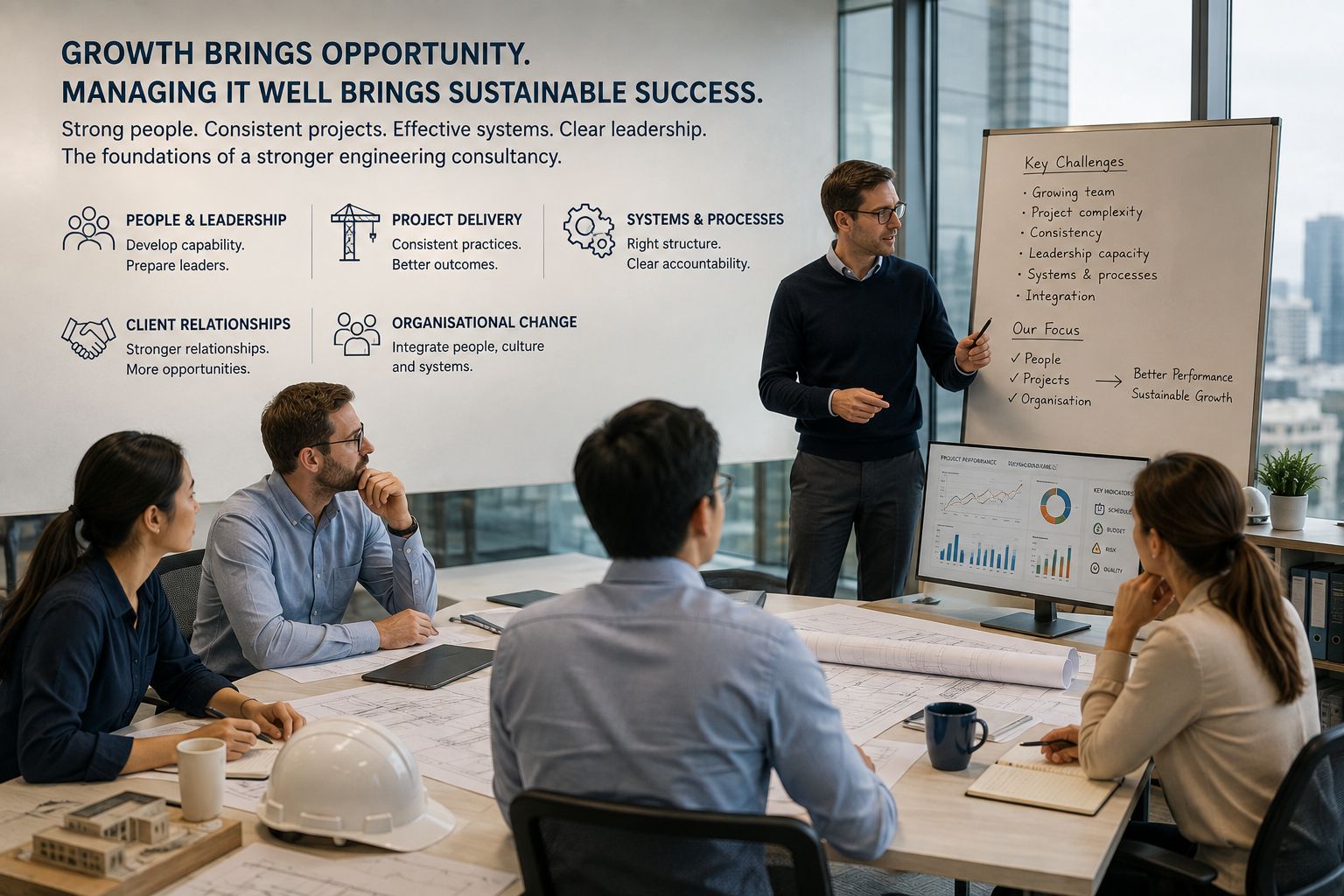
Where can the pressure show up?
People and leadership
As a consultancy grows, technically strong engineers are often asked to take on project management or leadership responsibilities.
Technical expertise is essential, but these roles require additional capabilities — managing people, communicating with clients, understanding commercial considerations, managing risk and making decisions.
Without appropriate development and support, capable engineers can find themselves taking on responsibilities they have had little opportunity to prepare for.
Project delivery
Growth can also make consistent project delivery more difficult.
Different project managers may develop different approaches to planning, risk, reporting, commercial management and client communication.
This may not be a significant issue in a small organisation where people work closely together. As the business grows, however, inconsistency can become more visible — and more costly.
The challenge is to establish enough consistency and control without removing the professional judgement that good project managers need.
Systems and processes
As organisations grow, informal communication and individual knowledge become less reliable.
Processes that were previously managed through conversations and personal relationships may need greater structure.
Responsibilities, reporting, decision-making and accountability may need to evolve to provide the visibility and consistency that a larger organisation requires.
The objective should not be to create unnecessary bureaucracy. It is to have the right level of structure for the size and complexity of the business.
Client relationships and consulting capability
Engineering consultancies compete on more than technical expertise.
Clients also value communication, responsiveness, commercial awareness, sound advice and an understanding of their broader needs.
As firms grow, maintaining a consistent standard of client service across different teams and individuals becomes increasingly important.
This means that consulting and client-management skills need to develop alongside technical capability.
Organisational change and integration
Growth through merger, acquisition or other forms of organisational change presents additional challenges.
Different organisations may have different cultures, systems, processes, management styles and ways of working.
Bringing them together is therefore more than a structural or financial exercise.
People need to understand how the new organisation will operate. Managers need clarity about their responsibilities. Systems and processes may need to be aligned. Teams need time and support to establish new ways of working.
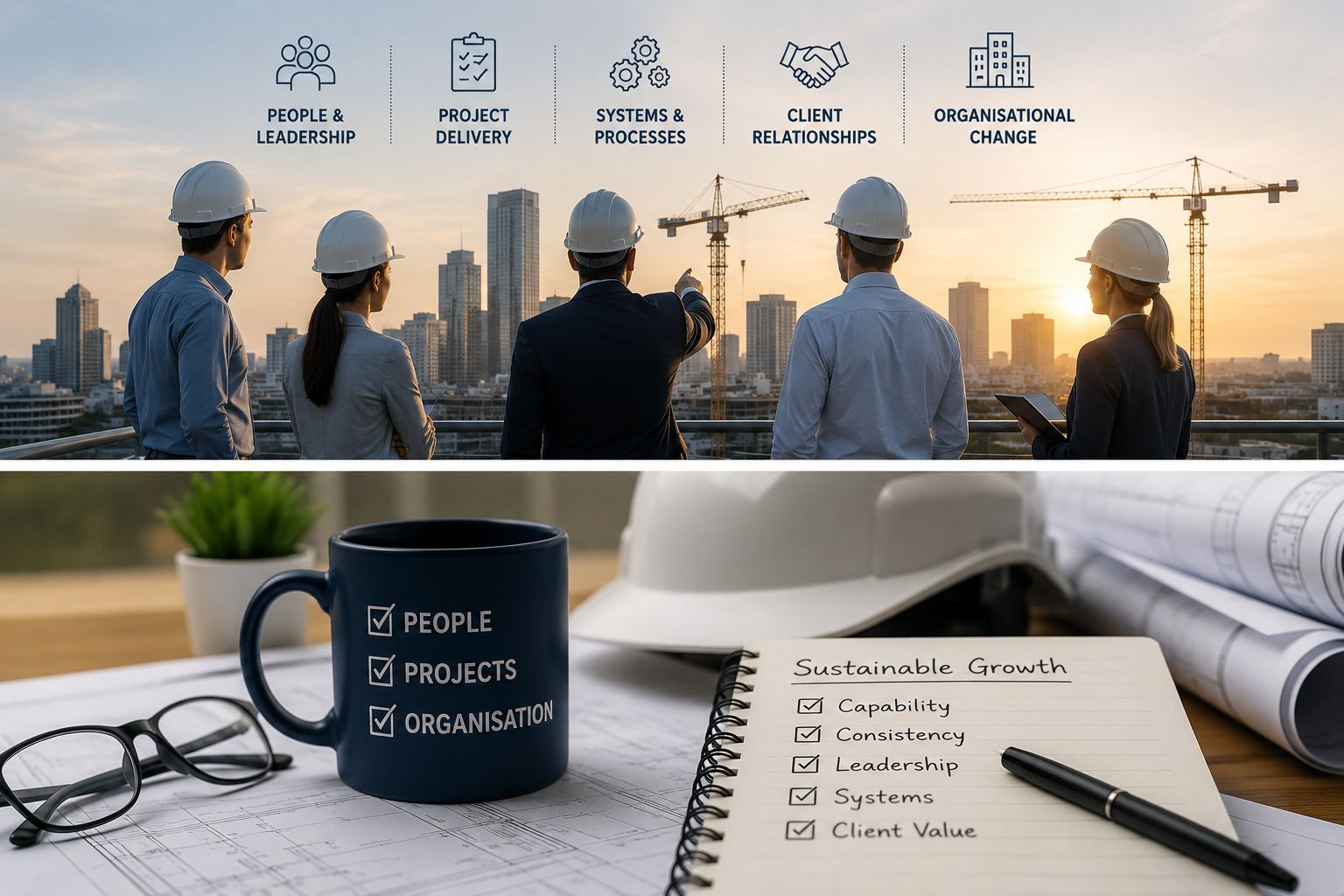
Growth can expose issues that were previously less visible
Growth doesn't necessarily create problems. It can expose weaknesses that were previously less visible.
A process that worked adequately for 15 people may not work as well for 50.
A project-management approach that worked for relatively straightforward projects may become less effective as project complexity increases.
An engineer who performed exceptionally well technically may need additional support when moving into a leadership role.
These are normal challenges associated with organisational development.
The important question is whether the business recognises them early enough to respond effectively.
What should leaders be asking?
There is no single solution that applies to every engineering consultancy. Priorities will depend on the firm's size, structure, markets, people and stage of development.
However, some questions are worth asking:
- Are our project managers equipped for the responsibilities they now have?
- Are projects being managed consistently across the business?
- Do our systems and processes support the way we operate today?
- Are responsibilities and accountability clear?
- Are we developing the next generation of engineering leaders?
- Do our people have the consulting and client-management skills needed to support growth?
- If we are integrating another business, have we considered the people and operational aspects as well as the commercial ones?
These questions can help identify where relatively targeted improvements may have a significant impact.
Growth should strengthen the business — not simply make it bigger
Sustainable growth requires the people, projects, leadership and organisational systems to develop alongside the business.
The engineering consultancies that manage this well recognise that growth is not simply about winning more work or employing more people.
It is about building the capability, consistency and organisational foundations needed to deliver that work effectively — while retaining the technical expertise and professional culture that made the business successful in the first place.